



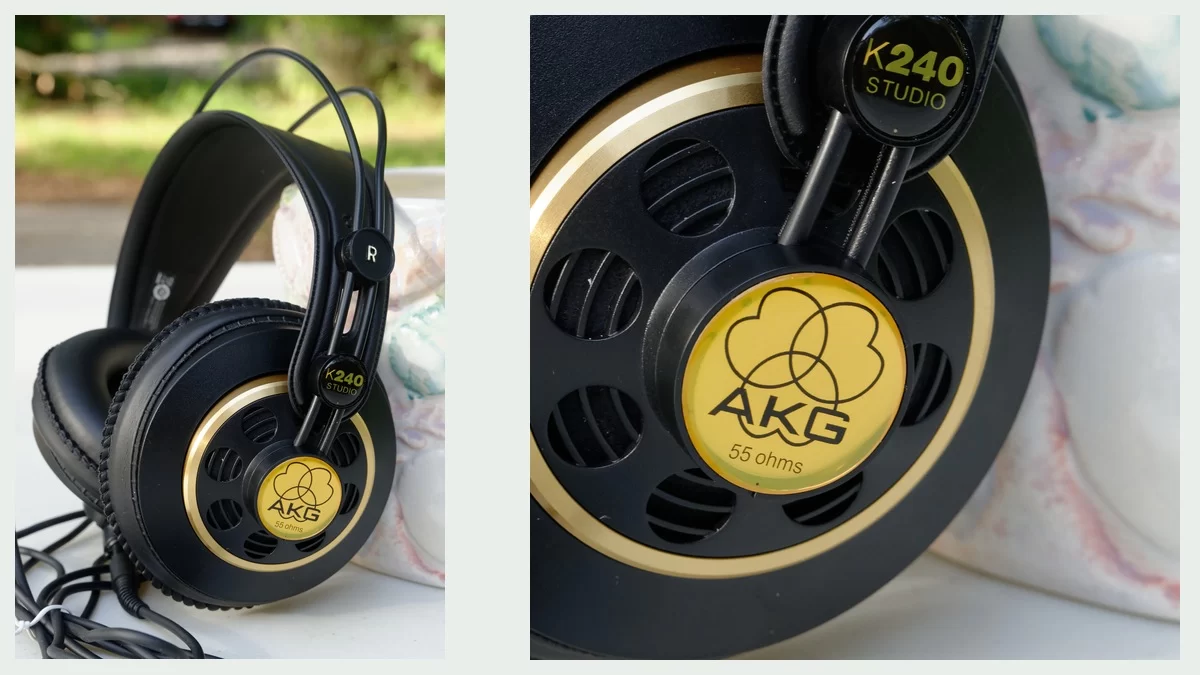
Read the label on the earcup before you buy a used AKG K240. The pair in our cover photograph says K240 Studio and 55 ohms. Another K240 can look familiar without being that model: Michael Heigl’s photograph shows an older pair marked Monitor and 600 ohms. If the advert has no readable label photograph, request one before ordering.

Once you know it is the Studio, there is another label to read carefully. AKG’s technical sheet gives sensitivity as 104 dB SPL per volt. You may be used to seeing headphone sensitivity quoted per milliwatt. Those units can explain a difference between specifications before you get as far as choosing an amplifier.
This guide uses that manufacturer document, issued in April 2019 and checked on November 12, 2026. We haven’t tested these headphones. The numbers below are calculations from AKG’s nominal figures, with no claim about a particular unit or listening setup.
One volt is more than one milliwatt here
For the 55 ohm Studio, one volt corresponds to approximately 18.2 milliwatts. The calculation is voltage squared divided by resistance: one divided by 55 watts, then multiplied by 1,000 to express it in milliwatts.
That is the input behind AKG’s 104 dB/V reference. To express the same nominal sensitivity per milliwatt, subtract 10 times the base-ten logarithm of 18.2 from 104. You get about 91.4 dB SPL per milliwatt. A figure around 91 and one of 104 can therefore be consistent with the same headphone. Reading both as “dB” and dropping the rest of the unit makes them appear to contradict each other.
It also helps to work backward. One milliwatt into 55 ohms requires about 0.235 volts, the square root of 0.001 times 55. You can check the result by putting that voltage back into the power calculation. It returns roughly one milliwatt, allowing for rounding.
Neither conversion is a recommendation to listen at those sound levels. They let you compare like units and understand the reference behind a specification. An actual headphone’s behaviour still needs measurement; we have not supplied one here.
What to ask the equipment maker
Suppose the manual for your existing equipment gives only a line-output voltage. That does not tell you what its headphone socket can supply. Find the headphone-output section and retain the load stated beside any rating. If the necessary information is missing, give the maker the model name and AKG’s 55 ohm, 104 dB/V specification when asking about compatibility.
Be equally precise about the cable. The Studio’s original package includes a detachable three-metre lead and a 6.3 mm screw-on adapter. Its equipment plug is stereo 3.5 mm; the earcup connection is three-pin mini XLR. The adapter changes the plug’s size without changing the headphone’s impedance. It can make a connection fit, but it cannot provide extra amplifier power.
On a used listing, ask to see the lead and adapter alongside the headphones. For another lead, check that its supplier names the K240 Studio and shows the appropriate earcup connector. A 3.5 mm plug at the equipment end leaves half the cable unidentified. Our TRS and TRRS guide covers the separate issue of headphone and microphone contacts.
The specification cannot choose your room
AKG describes the Studio as semi-open and lists replaceable earpads. The first detail matters when sound escaping from the cups could disturb someone or enter a recording microphone. The second makes pad condition worth asking about on a used pair. Neither gives us grounds to promise isolation, comfort or the condition of a seller’s headphones.
Arrange an audition or a suitable return option for those questions. For recording, include the microphone in the check and listen back for spill. The paperwork can help you identify the model and understand its electrical figures; the final room and fit checks still belong with the actual pair.