



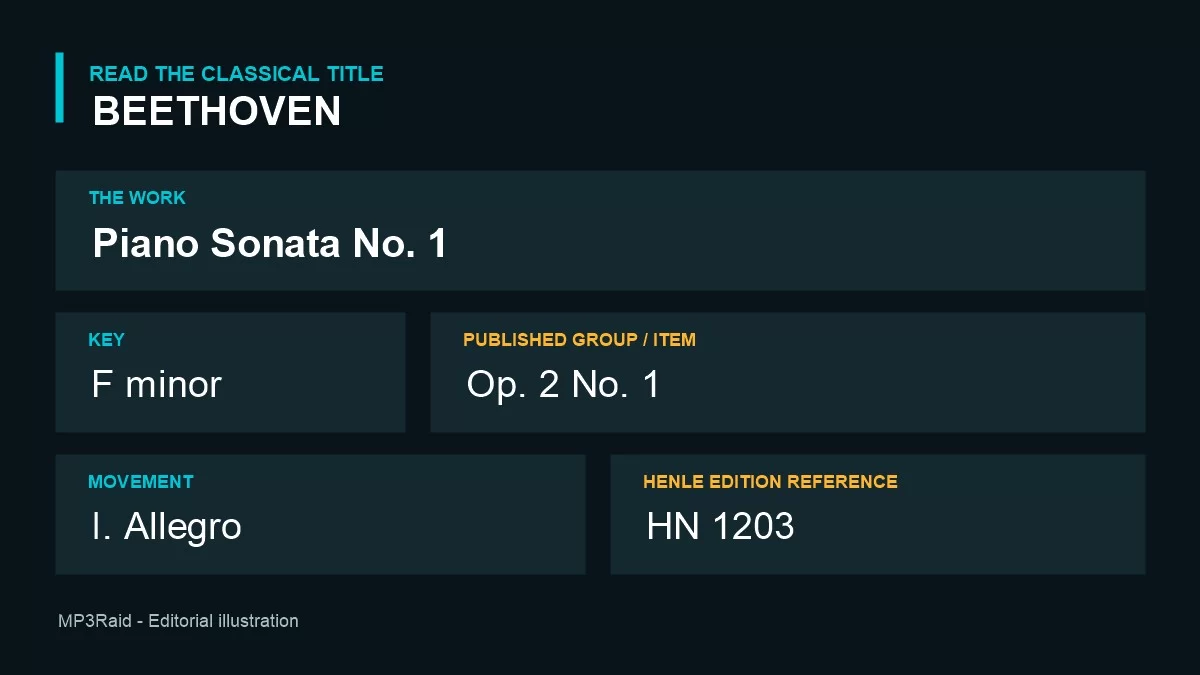
A bare “number 1” leaves too much out of a Beethoven search. There are three sonatas in the opus 2 group, and the first contains four movements of its own. A score publisher adds a reference for the book as well. Before saving a link, it helps to know which of those things the link actually identifies.
For this guide, we compared Henle’s score listing with the IMSLP work list. The publisher calls the piece Piano Sonata number 1 in F minor, opus 2, number 1. Its reference for the edition is HN 1203. The work and the publication have different identifiers on the very same page.
Keep the opus and its item number together
Henle’s description confirms that opus 2 contains three sonatas. In the manually maintained IMSLP list, the F-minor sonata is followed by number 2 in A major, opus 2, number 2, and number 3 in C major, opus 2, number 3.
Read across those entries and the pattern becomes visible. The opus stays at 2; the number after it changes from one sonata to the next. The number 1 in “Piano Sonata number 1” belongs to the numbered work title. The number 1 after opus 2 selects an item in that group. They agree here, but they are doing separate jobs.
That comparison is also a check you can use on a shortened listing. A major with opus 2, number 2 points to the second sonata, not a different edition of the F-minor one. Keeping the key as well as the opus in a saved note makes the mismatch easier to catch.
Check how much of the sonata you have found
Henle describes four movements in the F-minor work. IMSLP’s individual entry lists Allegro, Adagio, Minuet with Trio, and Prestissimo.
Here a Roman I with Allegro means the first movement, while IV with Prestissimo means the fourth. Those are parts within one sonata. They are a level below the three works grouped under opus 2.
If you want the whole sonata, the right work title is only half the check. Look for all four movements in the release information. If you want the slow movement, retain “Adagio” in your note so that your smaller selection is clear. A player’s queue number won’t travel as well between releases; it only describes a position in that sequence.
Keep HN 1203 for the score search
The HN reference is useful when you want the Henle publication cited above. It cannot settle your choice of recording. The page’s credits make that distinction more important: Murray Perahia and Norbert Gertsch are named as editors, with Perahia also credited for piano fingering. That is work on the score, not evidence of who performs on an unrelated recording.
As our album credits guide explains, the role attached to a name is part of the information. A pianist can appear on a page in an editorial role.
For a recording, our suggested note is “Beethoven — Piano Sonata number 1 in F minor, opus 2, number 1 — complete; pianist still to choose.” For the printed publication, add “Henle HN 1203.” For just one part of the work, add its movement name.
That leaves three choices separate: which composition, how much of it, and which edition or recording. This is a source-based title guide, not a listening comparison.