



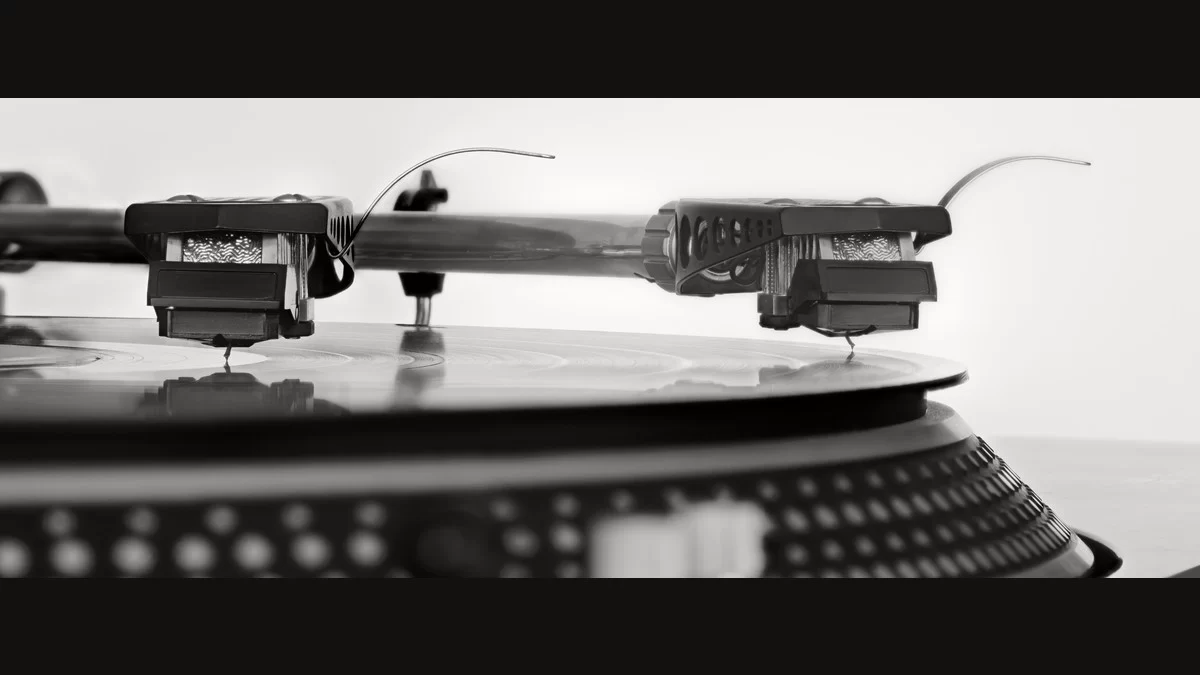

Jack White’s notes for the Lazaretto Ultra LP say both sides end in locked grooves. Here’s what that means if you’re about to play the record. A stylus that reaches the last groove can keep going round it. You can hear the same sound over and over without touching the record player.
A locked groove is easy to picture if you think about where the stylus is going. For most of a record side, it follows a spiral. It moves across the surface a little with every turn. At a lock the path joins back up with itself, like a circle. One turn of the disc brings the stylus round to the same bit of groove. A cutting engineer can leave that loop quiet or record sound in it. The music or noise in the groove has less than two seconds to come round again at either of the usual speeds.
What you can tell from one revolution
Take a record at 45 RPM. In a minute it makes 45 turns, so 60 seconds divided by 45 gives you about 1.33 seconds for one turn. At 33 and a third RPM the same calculation gives you 1.8 seconds. A sound in the groove can be shorter than that. You’ll still have to wait for the rest of the circle before you hear it start again. If you can’t see a speed printed on your single, start with our guide to choosing the right speed for a seven-inch record.
There’s a catch with watching the label go round. If an ordinary groove is damaged and throws the needle back, that sound can repeat once a turn too. Look at where the repeat began. If it’s halfway through a verse, lift the arm with the cueing lever and inspect the disc and stylus according to the equipment makers’ instructions. If you’re near the label at the end of the side, see whether the edition describes a locked ending. Check the turntable manual as well if the arm lifts on its own. You may only get part of the loop before the player ends the side.
The other places to look on Lazaretto
Jack White’s Ultra LP release notes put the two locked grooves at the ends of the two sides. Read a little farther and you’ll find two other features that don’t work that way.
The notes list one hidden track at 78 RPM and the other at 45, both under the centre labels. Where the notes say to find those tracks matters as much as the speeds. However long you wait in the end loop, you’re still playing the same turn of the groove.
The other feature is at the start of “Just One Drink.” The notes say the same song can begin with either an electric or an acoustic intro, depending on where the stylus lands. The grooves join for the rest of the song. Once they join, both paths take you into the track. You’d have to go back to the beginning to hear the other intro.
When you’re working out why something repeats on a record, write down where it happened and look up the edition. A catalogue number and the writing in the runout can help pin down the version. Once you have that, you can look for a note about the ending. The artist’s Ultra LP notes settle the question for Lazaretto. The next record with a repeating ending will have its own story.