



Is a record being sold as a test pressing because it says so on the label, or because the label is blank? Ask the seller. Test copies are made for a production check, and there should be a way to connect the disc being offered to that work.
You may want a copy precisely because it belonged to that process. Someone else may simply want to hear the album. The same listing needs to answer different questions for those two buyers. This is a source-based guide; MP3Raid has not inspected or played a record for this article.
What is being tested?
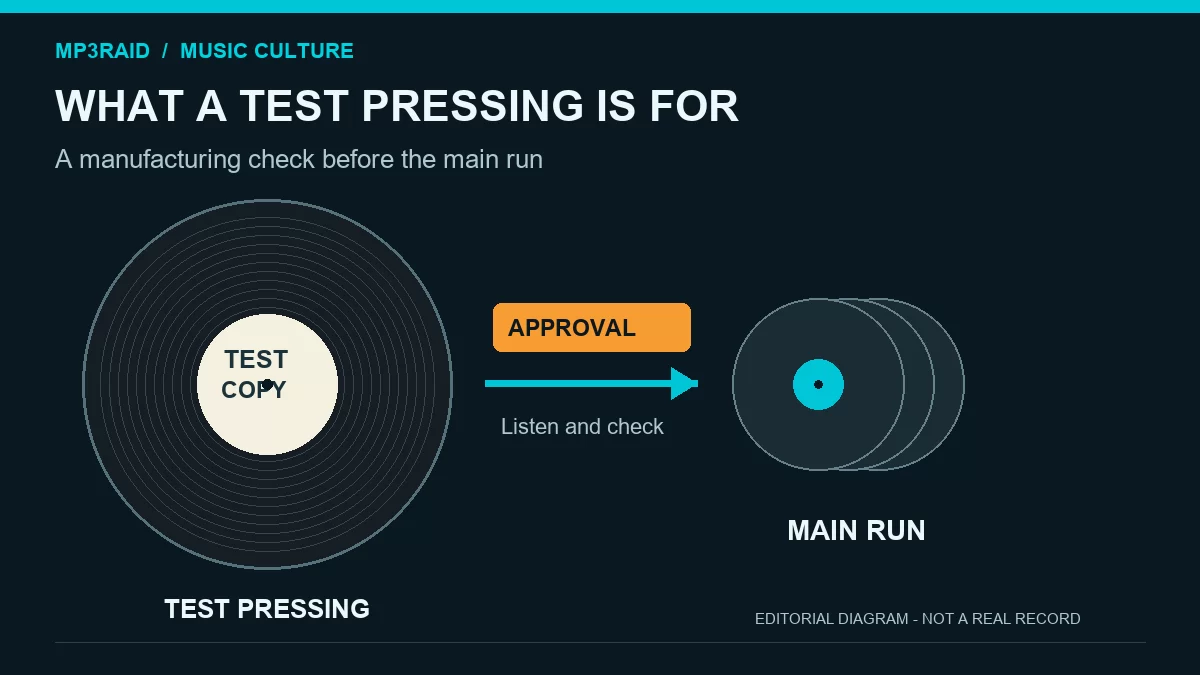
Pressing plant Hellbender Vinyl describes test pressings as a small run from the same stampers intended for production. Its usual quantity is three to five copies. Other plants and releases can have different quantities.
At this point the artist, label or mastering engineer can listen through the cut. The checks include the song order and the identification of each side. A beautifully printed sleeve would not help with either task; the music and the markings are what need attention.
RPM Records explains another consequence of this stage: changes to the supplied master or track sequence may require new master discs and stampers. An incorrectly sequenced side can therefore mean more than correcting a track list on the sleeve. The audio on the disc may have to be made again.
Does a white label prove the identity?
Discogs treats Test Pressing and White Label as separate database descriptions. Its format guidelines say a test pressing should be clearly marked as such. For its White Label tag, the important detail is the absence of mechanically applied print on both centre labels; the labels do not even have to be white.
That is a cataloguing rule, not a certificate issued to a seller. So there is little to learn from the colour on its own. A photograph of a blank label tells you something about appearance. A printed plant reference, a catalogue number or a note kept with the disc gives you something else to check.
Printing on a test label is useful information to read, not a reason to rule the record out.
What about the sound?
For RPM Records, the aim is an approved test pressing that sounds the same as a regular pressing. The plant does not present it as a premium version of the album. That makes sense when you remember what is being approved: the production that will supply the ordinary copies.
Hellbender’s guide mentions imperfections on individual test copies that may not represent the final run. RPM’s instructions for investigating a fault include playing different copies on different systems. A collector usually has much less evidence to work with than the people doing those checks. For a used record, you still need information about the condition of the copy being offered.
What to ask before buying
A useful message to a seller can cover three things:
- Ask for clear photographs of both labels and the runouts. Write down the catalogue reference exactly, including any test-pressing wording.
- Ask where the copy came from and what paperwork supports that account. If a name has been written on the label, ask who wrote it and how the seller knows.
- Then ask about playback: has this copy been played through, and were any skips or persistent noises noted? Keep that answer separate from the account of its origin.
Our runout-code guide covers the next step of matching markings to an edition listing. A match can help narrow the search, but read it with the label photographs and the seller’s account. For example, a photographed plant label and a matching catalogue reference give you a clearer question to investigate than an unexplained “rare test” description. You still need the playback answer before treating either listing as a good listening copy.