



An amplifier can double its output power and gain only about 3 dB. Yet a doubling of voltage can give about 6 dB. The missing detail is the quantity being doubled: across a fixed resistance, twice the voltage produces four times the power.
Here is a way to check the arithmetic without buying or connecting any equipment. We’ll follow a power change, then describe the same size of change through voltage. In these examples, the starting value is the reference. We are calculating a change, not an absolute sound level.
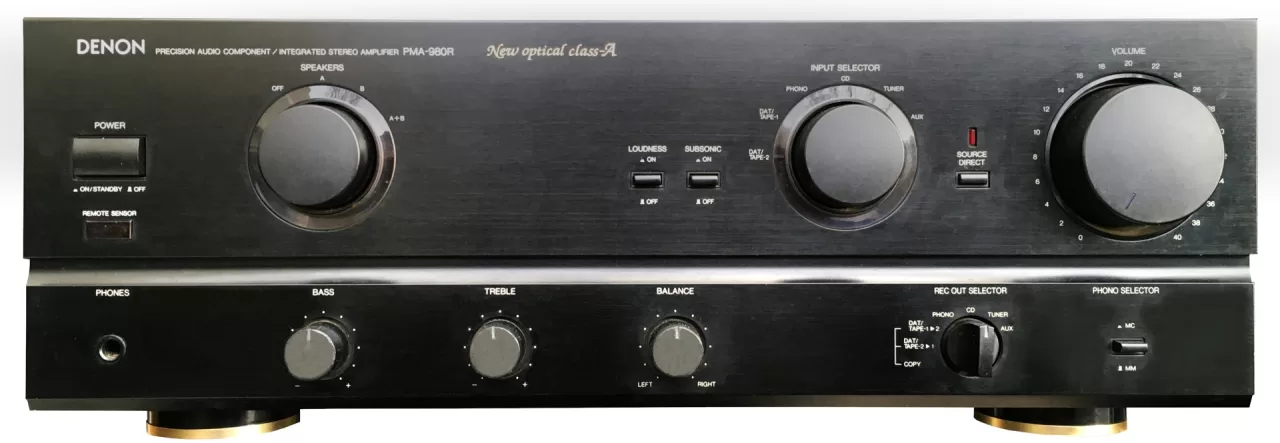
The formulas come from Yamaha’s decibel tutorial. MP3Raid calculated the examples below. They are not test results for the amplifier pictured above, which is an equipment illustration.
Take a 2-watt starting point
Suppose one amplifier is delivering 2 watts and you increase its output to 8 watts. Divide the new power by the old power: 8 ÷ 2 = 4. That is the ratio we need, rather than the extra 6 watts.
Enter 8 ÷ 2 into a calculator, take its base-10 log, then multiply by 10. The result is about 6.02 dB. Written out, our calculation is 10 × log10(8 ÷ 2). Keep the brackets: the ratio belongs inside the logarithm.
You can also trace the change without a calculator. From 2 to 4 watts is one doubling, worth about 3 dB. From 4 to 8 watts is another doubling, worth another 3 dB. Add the steps and you have about 6 dB. You have used four times the starting power to get there.
This is why a wattage difference and a power ratio are different questions. Increasing 2 watts to 4 watts and increasing 4 watts to 8 watts both add about 3 dB, even though the second step adds twice as many watts as the first.
Check the same relationship in volts
Put an imaginary 8-ohm resistor in the calculation. With 1 volt RMS across it, power is voltage squared divided by resistance: 1 × 1 ÷ 8 = 0.125 watt. At 2 volts RMS, it becomes 2 × 2 ÷ 8 = 0.5 watt.
The voltage doubled; power went up fourfold. Applying the power formula to 0.5 ÷ 0.125 gives the same 6.02 dB as the earlier example.
There is a shorter route when you already have the voltages: 20 × log10(2 ÷ 1) also gives about 6.02 dB. The multiplier changes from 10 to 20 because voltage is squared in the power calculation. It isn’t an extra gain to add on top.
Keep that resistor in the example. A real loudspeaker’s impedance varies with frequency, so this neat calculation is not a complete description of an amplifier driving music into a speaker.
What is still missing?
So far, we have compared electrical quantities. We have not measured the sound at a chair, specified a room or chosen a speaker. Yamaha’s speaker example adds sensitivity to the power calculation before estimating sound-pressure output.
Yamaha also distinguishes sound intensity from sound pressure. Doubling intensity corresponds to about 3 dB; doubling pressure corresponds to about 6 dB. Neither statement by itself tells you that a listener will describe the result as twice as loud.
Use the number on the right question
A useful note beside a specification would read: “This is a power rating, measured into this load, under these conditions.” If those details are missing, leave the comparison open. For a speaker, add its sensitivity and the conditions attached to that figure. Power handling and sensitivity are different specifications.
If your problem is that one album plays louder than the next, start with volume normalization settings. That addresses the playback level of the music. A larger amplifier power rating describes equipment capability; it does not automatically even out a playlist.