



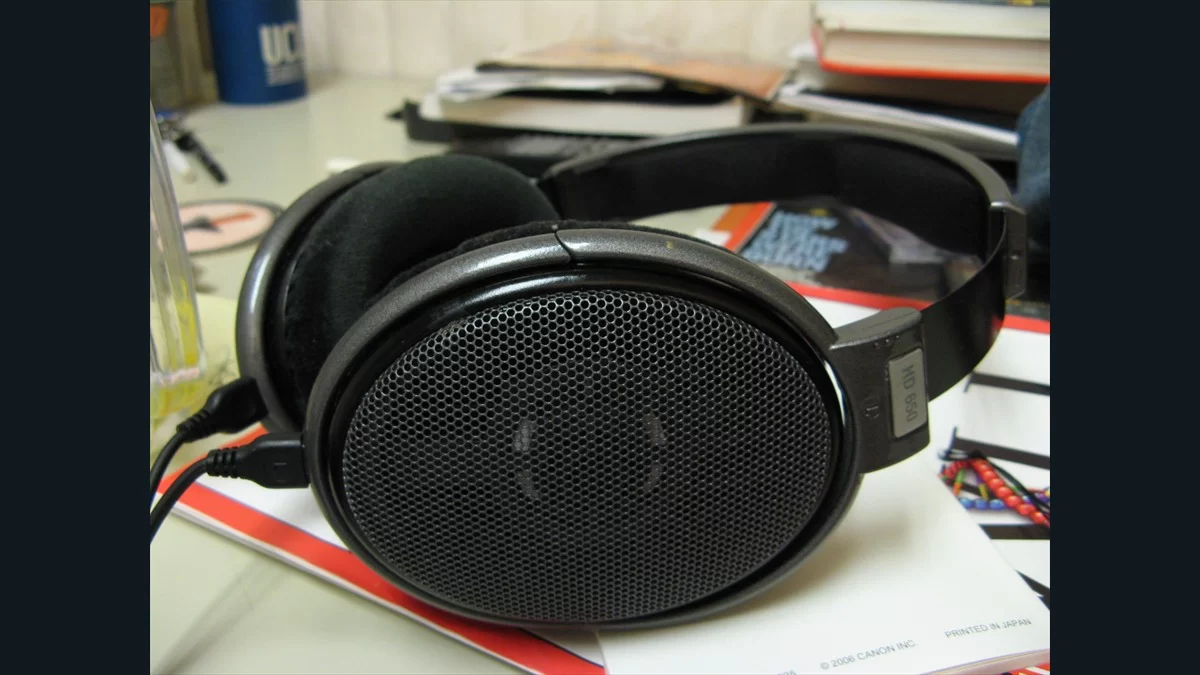
Check where the HD 650 will sit in your day. In a quiet room, an open-back headphone can be an option. At a desk beside a television, or beside someone who needs silence, its open earcups are a reason to reconsider. Buying an amplifier leaves that room problem unresolved.
This is a source-based guide to the HD 650's published specifications, with our own nominal-load calculation. MP3Raid hasn't physically tested the headphone, measured its sound or assessed its fit.
Find the socket before choosing an amplifier
Write down the device you intend to use: a computer, an audio interface or a separate headphone amplifier. Then look at its headphone socket. Does the plug supplied with the pair you're buying fit it?
The detachable cable appears in Sennheiser's specification. A used listing needs a closer look at what the seller will actually send. Ask for the cable and adapter details, then compare them with your socket.
Consider a hypothetical setup with a 3.5 mm headphone jack and an output rating published only for a 32-ohm load. There are two gaps to fill. The seller can tell you whether the supplied cable needs a plug adapter. The device manufacturer can address the output at 300 ohms. An adapter answers the first question; it supplies no answer to the second.
What 300 ohms lets us calculate
Sennheiser's figures are 300 ohms nominal impedance and 103 dB at 1 V for sound pressure. That last part, at 1 V, belongs with the sensitivity number: it isn't a per-milliwatt figure.
For a simple example, treat the load as a fixed 300-ohm resistance. Using power = voltage squared divided by resistance, we get:
| Example voltage, RMS | Calculated power at 300 ohms |
|---|---|
| 1 V | About 3.33 mW |
| 2 V | About 13.33 mW |
The first calculation is 1 squared divided by 300: approximately 0.00333 watts. For the second, 2 squared divided by 300 gives approximately 0.01333 watts. Converting watts to milliwatts gives the values in the table.
That is why doubling the voltage produces four times the power here. Neither row recommends a listening level. We haven't connected an HD 650 to an output and measured these results; they follow from the fixed-resistance assumption. A real headphone's impedance varies with frequency. This simplified calculation can't verify that behaviour or show where a particular amplifier clips.
Ask for the missing output condition
Now read the specifications for your existing device. Look for its headphone-output rating and the load used for that rating. If you only find power into 32 ohms, you still need information about its performance into 300 ohms.
A useful question for the manufacturer is: what RMS voltage can the headphone output deliver into a 300-ohm load before clipping? Name the socket in your question. A line-output figure from elsewhere in a DAC's specification won't necessarily describe its headphone jack.
Keep the answer with your buying notes, including the load and which socket was rated. Our USB-C DAC connection guide explains the connector checks if you're planning to use a phone or laptop adapter.
Inspect the pair you will receive
The licensed photo here shows an older finish of the HD 650. It identifies the model, rather than showing a current retail package or an MP3Raid test sample. For a used purchase, request photos of the actual pair and a list of included accessories.
Replacement earpads and cables are listed by Sennheiser. Check the exact replacement part against your model, then confirm that you can obtain it where you live.
The remaining unknown is fit. Find out whether you can arrange a demonstration, and read the return terms before ordering. We haven't worn this pair, so the guide can't resolve comfort for you. You can finish the paperwork checks in advance: room, included cable, socket, rated load and replacement parts. Leave the decision about how it feels to an actual fitting.