



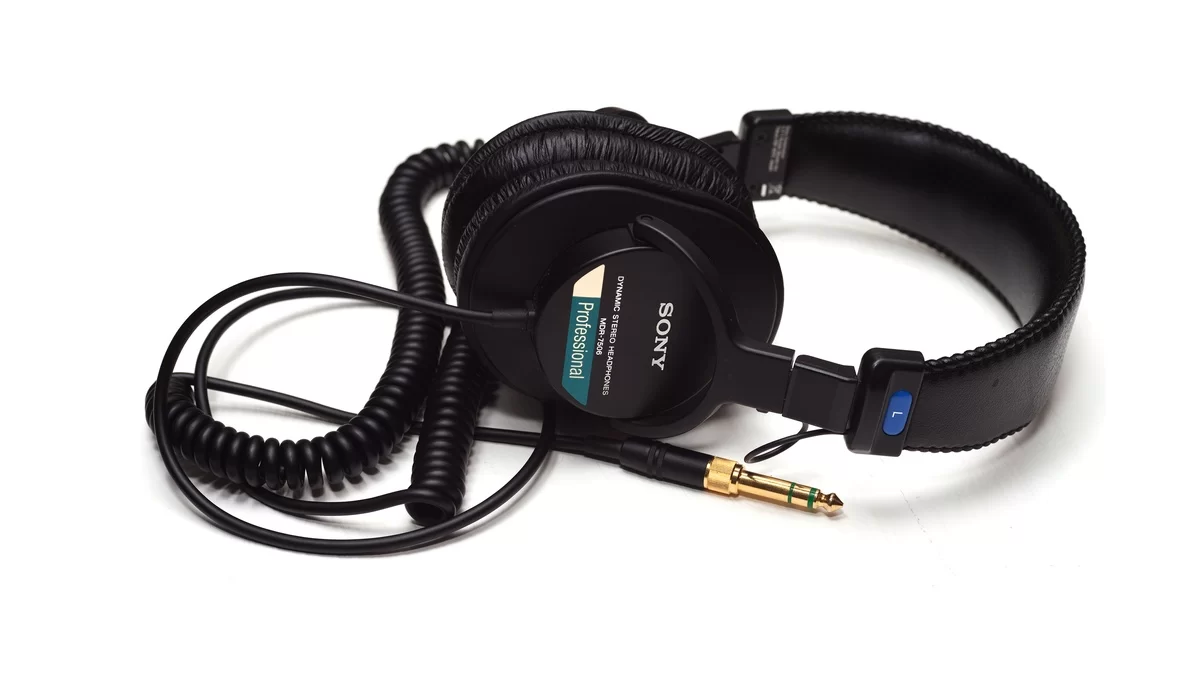
Buying the MDR-7506 for a laptop raises a small question before any discussion of sound: which microphone will you use for calls? RTINGS lists no mic on the headphones. You would still need the laptop’s microphone or a separate one. It also lists no wireless connection or active noise cancellation.
The other immediate check is the socket. A USB-C-only phone will need a compatible audio adaptor. This source-based review uses Sony’s specifications and RTINGS’ physical review. MP3Raid hasn’t tested or listened to the MDR-7506. The archive product photograph is credited to Ashley Pomeroy.
The useful part of a long lead
Sony gives the cable length as 9.8 feet. Multiplying that by 0.3048 converts it to 2.987 metres, or roughly three metres. This is a conversion of the published specification; we haven’t stretched out the coil and measured it.
Imagine a headphone socket under a desk and a two-metre route around the furniture to your chair. Subtracting that route from the published length leaves roughly a metre. That is a planning example only: the cable is a coil, and we haven’t measured how it behaves when pulled around furniture.
RTINGS describes the lead as coiled and non-detachable. There is no earcup socket for a quick cable swap. Keep that in mind if the lead would sit where a chair wheel could catch it. A repair and a plug-in replacement are different jobs.
In the box, Sony includes a carrying pouch and a Unimatch adaptor that accommodates 3.5 mm and 6.3 mm sockets. That takes care of two analogue socket sizes. It does not turn a USB-C port into an analogue headphone output. Our USB-C DAC guide explains the extra conversion that a compatible digital audio adaptor provides.
Read the isolation finding before the studio label
The official specification describes 40 mm dynamic drivers, a closed design and 63-ohm impedance. For travel, the important question is how much outside noise gets through. RTINGS’ test gives a reason to be cautious about that assumption: it reports poor isolation from subway rumble and accelerating buses.
The review also calls the headphones comfortable and relatively lightweight, and identifies their sound profile as bright. These are findings from one outside physical review. MP3Raid has no measurements or listening comparison to add.
Someone sitting alone at home may be comfortable accepting the reported isolation limit. Someone choosing headphones for a train has a stronger reason to look elsewhere. The room and journey matter here; “closed-back” by itself does not answer either question.
Leave room for an audition
A specification sheet cannot tell you whether the fit or treble balance will suit you. If possible, audition the pair with the source you intend to use. The 63-ohm number alone won’t establish the output available from that source, so check its headphone-output information before ordering an amplifier as well.
For our editorial shortlist, the Sony fits a fixed desk with an analogue connection and a workable route for the coil. It loses that practical advantage when the lead becomes something to carry and manage on every journey. We would make that setup decision first, then audition for comfort and sound.